

How to Fix Rounded Shoulders From Desk Work
Table of Contents
- Why Desk Work Rounds Your Shoulders
- Rounded Shoulders Exercises to Rebuild Upper-Back Strength
- Desk Stretches for Shoulders That Undo the Slouch
- Desk Ergonomics for Posture: Setting Up Your Workstation
- How Long Does It Take to Improve Rounded Shoulders?
- A Practical Desk-Work Routine With Timing and Progression
- Pain, Warning Signs, and When to See a Professional
- Conclusion
- Frequently Asked Questions
Last Updated: October 18, 2026
Why Desk Work Rounds Your Shoulders
Rounded shoulders from desk work happen because your body adapts to the shape you hold most.
At PosturePlank, we hear the same story from office workers, golfers, and parents alike.
Here is the key point most guides miss: rounded shoulders are a muscle balance problem, not a willpower problem.
The American Council on Exercise guide to posture notes that prolonged sitting tightens the chest and hip flexors while weakening the back.
- Tight chest muscles pull the shoulders inward
- Weak upper back fails to hold the shoulder blades back
- Forward-head posture adds load to the neck
Rounded Shoulders Exercises to Rebuild Upper-Back Strength
The fix starts with strengthening the muscles that pull your shoulder blades back and down. You need scapular control, not just raw pulling power. Aim for 2-3 sessions per week, and keep the reps slow and controlled.
Band Pull-Aparts and Prone I, T, Y Raises
These four moves target the shoulder blades and the muscles between them. Do them as a circuit.
- Band pull-apart: 2-3 sets of 12-15 reps, pulling the band apart at chest height
- Prone I raise: 2 sets of 10, arms overhead in a Y shape, lifting only the arms
- Prone T raise: 2 sets of 10, arms out wide, squeezing the shoulder blades together
Keep the neck relaxed. If your shoulders shrug toward your ears, lighten the resistance.
Lower Trapezius and Rhomboid Work
The lower trapezius and rhomboids hold your shoulder blades down and back. Weakness here is why your shoulders drift forward.
Try these:
- Prone W raises: 2 sets of 10, elbows bent, squeezing the blades down
- Seated row with a band: 2-3 sets of 12
- Wall angels: 2 sets of 8, back flat against the wall
A common mistake is chasing heavy weight. Posture work rewards control, not load.
Desk Stretches for Shoulders That Undo the Slouch
Desk stretches for shoulders work best when you hold them long enough to actually lengthen the tissue. Aim for 20-30 seconds per stretch, 2-3 rounds, once or twice a day. Breathe out as you settle into each one.
Doorway Stretch and Reverse Shoulder Stretch
The doorway stretch opens the tight chest muscles that pull your shoulders forward.
- Stand in a doorway with forearms on the frame, elbows at shoulder height
- Step one foot through until you feel a stretch across the chest
- Hold 20-30 seconds, then relax and repeat
The reverse shoulder stretch targets the back of the shoulder and the rear deltoid.
- Clasp your hands behind your back
- Straighten your arms and lift gently
- Squeeze the shoulder blades together and hold 20-30 seconds
Add a neck stretch by tilting your ear toward your shoulder and holding 20 seconds per side. Tight neck flexion often travels with rounded shoulders.
Desk Ergonomics for Posture: Setting Up Your Workstation
Desk ergonomics for posture is about removing the reasons your body slumps. Small setup changes reduce the load that drives your shoulders forward all day. Most guides tell you to "improve ergonomics" and stop there.
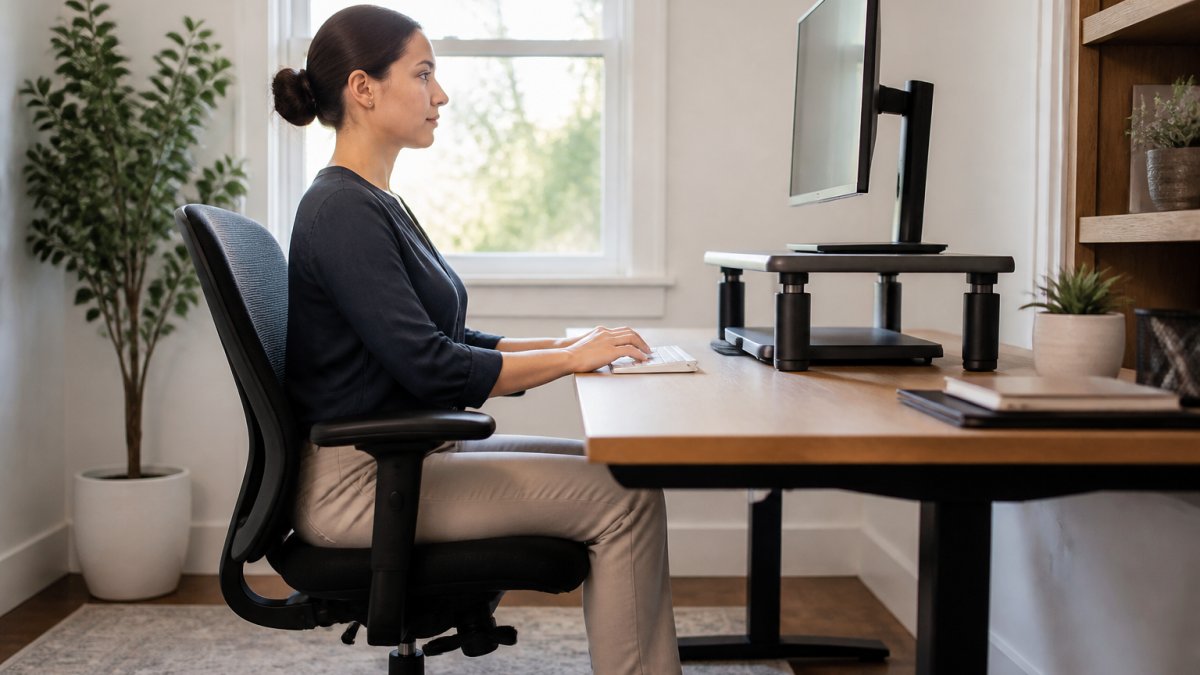
Set Up in This Order
Adjust from the ground up. Changing the monitor before the chair is the most common mistake, because raising the chair later throws off everything above it.
- Feet and floor. Feet flat, thighs roughly parallel to the floor. If your chair is too tall, use a footrest rather than letting your feet dangle.
- Seat depth and back support. Leave about 2-3 inches between the back of your knees and the seat edge. Set the lumbar support into the small of your back, not the mid-back.
- Elbows and keyboard. Elbows bent to roughly 90 degrees, forearms level or angled slightly down. Keyboard and mouse close enough that your elbows stay near your sides, reaching forward is what pulls the shoulders out of position.
- Monitor height and distance. Top of the screen at or slightly below eye level, about an arm's length away (roughly 20-30 inches). If you wear progressive lenses, you may need the monitor slightly lower so you are not tilting your head back.
- Shoulders. Relaxed down and back, not shrugged. If your shoulders creep up, your keyboard or monitor is probably too high.
Measurable Targets to Check
- Monitor top edge: at or just below eye level when you sit tall
- Screen distance: one arm's length, about 20-30 inches
- Elbow angle: about 90 degrees, forearms roughly level
Laptop-Specific Fixes
A laptop forces a trade-off: the screen and keyboard are attached, so you cannot set both correctly at once. The fix is to separate them.
- Add a stand to raise the screen to eye level, then add a separate keyboard and mouse so your hands stay low.
- If you use a laptop without a stand for short stretches, tilt it up on a wedge and keep sessions short.
- For dual monitors, put the primary screen directly in front of you and angle the second one rather than twisting your neck all day.
Perching a laptop on your lap or a low table forces your head down and your shoulders forward for hours. If you work on a laptop all day, add a stand and a separate keyboard.
Movement Beats Perfect Setup
No setup is perfect enough to cancel out hours of stillness. Even with an ideal station, stand or walk every 30-45 minutes. A two-minute break to roll your shoulders, stand tall, and reset your shoulder blades does more for rounded shoulders than a millimeter of monitor adjustment.
The Occupational Safety and Health Administration computer workstation guide covers monitor height, chair setup, and neutral postures in detail. Use it as a checklist alongside the targets above.
How Long Does It Take to Improve Rounded Shoulders?
Most desk workers notice less tightness within 2-4 weeks of consistent daily work. Visible posture change usually takes 6-12 weeks. Full retraining of posture habits can take several months.
That timeline assumes you do the work most days. Sporadic effort stretches it out.
Progress is not linear. Some weeks feel better than others. Judge by the trend, not a single bad day.
A Practical Desk-Work Routine With Timing and Progression
Most articles hand you a pile of exercises and leave you to figure out the order. This section gives you a complete desk-work plan: what to do, in what order, how many sets and reps, and how to progress week by week. Total time is about 12 minutes on strength days and under 5 minutes on movement-break days. No gym required, just a resistance band and a wall.
The Weekly Structure
- Daily: movement breaks every 30-45 minutes during the workday, plus one chest stretch in the morning and one in the evening.
- 3 days per week (e.g., Monday/Wednesday/Friday): full strength circuit.
- 2 days per week (e.g., Tuesday/Thursday): mobility and stretch focus.
Daily Movement Breaks (Every 30-45 Minutes)
Set a timer or use a standing reminder. Each break takes 60-90 seconds:
- Stand up and roll your shoulders back 5 times.
- Do 5 slow shoulder-blade squeezes, holding each for 2 seconds.
- Do 5 gentle chin tucks (pull your chin straight back, not down).
- Reach your arms overhead and take one deep breath.
Strength Circuit (3 Days per Week)
Do these in the order listed. The order matters: back work first, chest stretch last, so tired chest muscles do not pull your shoulders forward mid-session.
- Band pull-apart, 2-3 sets of 12-15 reps, band at chest height, slow return.
- Prone Y raise, 2 sets of 10, arms at 45 degrees, lift only the arms.
- Prone T raise, 2 sets of 10, arms out wide, squeeze the shoulder blades.
- Prone W raise, 2 sets of 10, elbows bent, pull the blades down and back.
- Seated band row, 2-3 sets of 12, elbows close to the body.
- Wall angels, 2 sets of 8, back flat against the wall.
- Doorway chest stretch, 2 rounds of 20-30 seconds per side.
Rest 45-60 seconds between sets. Keep reps slow, about 2 seconds out, 2 seconds back.
Mobility and Stretch Day (2 Days per Week)
- Doorway chest stretch: 2-3 rounds of 20-30 seconds per side
- Reverse shoulder stretch: 2 rounds of 20-30 seconds
- Neck side tilt: 20 seconds per side
Week-by-Week Progression
Start light and add difficulty only when the current week feels easy and controlled.
- Weeks 1-2: 2 sets per strength exercise, light band, focus on form. Do the daily movement breaks.
- Weeks 3-4: add a third set to band pull-aparts and rows. Keep other exercises at 2 sets.
- Weeks 5-6: 3 sets across all strength exercises. Begin slowing the tempo to 3 seconds per rep.
How to Assess Progress
Take a relaxed side-view photo every two weeks, standing naturally (not posed). Compare:
- Does your ear sit closer to over your shoulder?
- Do your shoulder blades sit flatter against your upper back?
- Has the end-of-day neck tightness eased?
Also note how many movement breaks you actually took. Consistency is the variable most likely to explain a good week versus a bad one.
Consistency beats intensity. A 12-minute routine done five days a week will change your posture faster than a hard session done twice. If you miss a day, restart the next day, do not double up.
Pain, Warning Signs, and When to See a Professional
Some soreness after new exercises is normal. Sharp pain, numbness, or tingling down the arm is not. Stop and get it checked.
See a professional if you notice:
- Pain that wakes you at night
- Numbness or tingling in the hands or fingers
- Weakness in the arm or grip
- Pain that gets worse despite weeks of exercise
If you have a herniated disc or chronic pain, talk to your doctor or physical therapist before starting a new routine.
The Mayo Clinic overview of neck pain causes is a useful starting point for understanding when symptoms need medical attention.
Conclusion
Rounded shoulders from desk work respond to a simple plan: strengthen the upper back, stretch the chest, fix your workstation, and move more often.
That is where a tool can help. The PosturePlank FLEX ($119.00) is a chiropractor-developed system built to train the muscles that support your spine, hips, and shoulders.

If you want a routine that holds up, start with the exercises above and add the PosturePlank FLEX to keep your posture work consistent.
Add PosturePlank FLEX to your cart and give your shoulders the support they need to stay back where they belong.
Frequently Asked Questions
Can desk work cause rounded shoulders?
Yes. Prolonged sitting with a forward-leaning posture keeps the chest muscles shortened and the upper-back muscles lengthened and weak. Over months, that imbalance becomes the default shoulder alignment. Screen position and slouching habits make it worse. The fix is not one stretch but a routine that combines strengthening, desk stretches, and a workstation setup that stops the slouch from returning every workday.
How often should I do rounded shoulders exercises?
Aim for strengthening work three to four times per week and short desk stretches daily. Band pull-aparts, prone I, T, Y raises, and lower trapezius work respond best to consistent, moderate volume. For desk stretches, a 30-second doorway stretch every couple of hours keeps the chest muscles from tightening back up. Frequency matters more than duration, so short sessions you actually repeat beat long ones you skip.
How long does it take to improve rounded shoulders?
Most people notice easier shoulder mobility and less tension within two to four weeks of consistent work. Visible alignment changes usually take eight to twelve weeks, and posture retraining takes longer because you are changing a habit, not just a muscle. Progress depends on how long the pattern has been set, how often you train, and whether your desk setup supports the change.
Can rounded shoulders be corrected without equipment?
Bodyweight exercises like prone I, T, Y raises, wall slides, and doorway stretches cover most of the work. A resistance band adds useful load for pull-aparts and rows, and a foam roller helps with thoracic extension. A posture training tool such as the PosturePlank FLEX ($119.00) can support the strengthening side of the routine, but it works alongside exercises and ergonomic changes, not as a replacement for them. If you have a herniated disc or chronic pain, clear any new routine with a qualified professional first.